The Second IEEE Programming Challenge at IWLS
The second IEEE Programming Challenge of the International Workshop on Logic and Synthesis (IWLS) was launched in December 2006. IEEE CEDA sponsored the challenge together with Synplicity, Cadence Design Systems and IBM. With the help of these funds seven participating students received a travel grant and could travel to the IWLS workshop held June 2007 in San Diego, California. In addition to the travel grants the committee of the programming challenge awarded two entries of the challenge with a Best Contribution Award.
The programming challenge was organized and co-chaired by Florian Krohm (IBM) and Christoph Albrecht (Cadence Berkeley Labs). A committee consisting of Surbarna Sinha (Synopsys), Fan Mo (Synplicity) and the two co-chairs judged the entries by how good the implementations make use of the OpenAccess database and the OA Gear infrastructure, how well the functionality is architected to allow maximum versatility, how the algorithms scale for large circuits, how good the unit and regression tests and the documentation are, and how well the OA Gear coding standard is followed.
The committee awarded the contribution by Donald Chai on Efficient
Redundancy Removal in Open Access
as the best contribution. With
redundancy removal Donald implemented a known but very relevant algorithm which
will be a great asset in the OAGear toolbox. Donald provided two versions
which trade memory for speed. Donald's great attention to technical detail
(such as cache-sensitive data layout) results in a very efficient and robust
implementation which is demonstrated by experimental results on the IWLS 2005
benchmarks. A modular software design with clear interfaces bounds the code
complexity and will be beneficial for future maintenance. The committee also
applauds the use of defensive programming techniques, as for example the
frequent use of asserts, and believes that his work will be of significant
value for further research with OA Gear. Donald's contribution is part of the
OAGear package released in December 2007.
More information: Technical abstract.
The committee has awarded the contribution by Smita Krishanswamy and
Stephen M. Plaza on AnSER: A Lightweight Reliability Evaluator for use
in Logic Synthesis
as the second best contribution of this year's
programming challenge. Smita and Stephen implemented a novel algorithm whose
runtime scales linearly with the circuit size. They have given a great deal of
thought to the software architecture of their solution. It is extensible and
allows the easy integration of new analysis algorithms and error models.
Changes in the logic design are tracked with the oaObserver facility and
computation of results is on demand. Their implementation is modular, easily
accessible and takes advantage of existing OA and OAGear infrastructure
including last year's simulation package. The commitee believes that their
work has laid the foundation for future research in circuit reliability within
OAGear. We have plans to also release this package in OAGear.
More Information: Technical abstract.
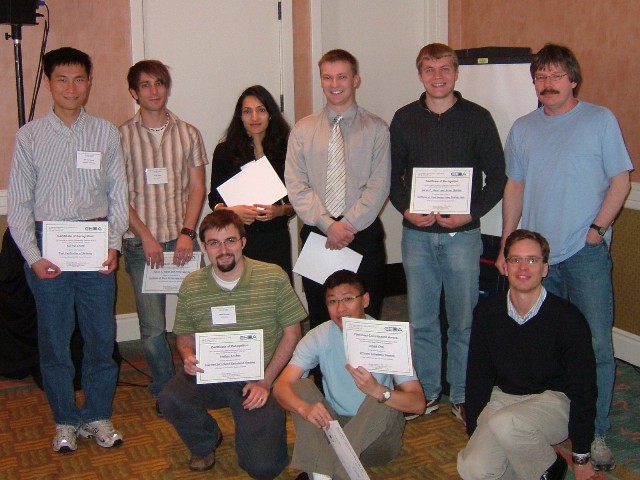
The second IWLS Programming Challenge winners with the event organizers. Left to right on the back row: Kai-hui Chang, Aaron Hurst, Smita Krishnaswamy, Stephen M. Plaza, Artur Quiring, and Florian Krohm. Front row: Nathan Kitchen, Donald Chai, and Christoph Albrecht.